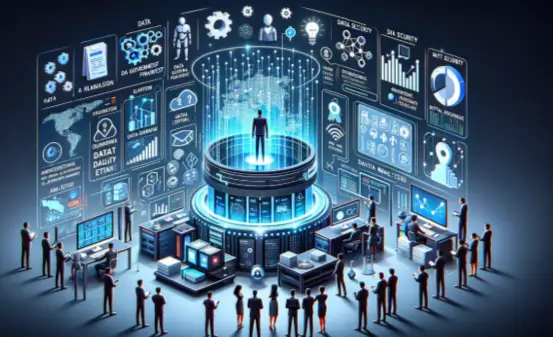

Data centers leverage AI to monitor signals from hardware, software, and the environment, translating patterns into actionable insights. Anomaly detection and predictive maintenance reduce downtime and extend equipment life. AI-driven orchestration balances workloads with cooling and power constraints, optimizing efficiency while preserving performance. It acts as a governance layer for security, compliance, and reliability, strengthening resilience through transparent risk management. The core capabilities, however, raise new questions about control, oversight, and future infrastructure evolution. The next step awaits exploration.
Detect, Predict, and Prevent: Anomaly Detection and Predictive Maintenance
Anomaly detection and predictive maintenance transform data centers from reactive to proactive systems. The approach monitors patterns across hardware, software, and environmental signals to identify deviations before failures emerge.
By leveraging anomaly detection, operators gain early warnings; predictive maintenance schedules interventions at optimal times, reducing downtime and extending equipment life.
This strategy aligns with freedom-focused design: resilient, self-aware infrastructure enabling purposeful, uninterrupted operations.
Optimize Workloads and Cooling With Ai-Driven Orchestration
Ai-driven orchestration enables dynamic alignment of workloads with available resources, repeatedly balancing performance, energy use, and thermal constraints. It leverages predictive scheduling to anticipate demand and adjust cooling and processing in real time, while workload categorization classifies tasks by priority and latency.
This approach unlocks efficiency, resilience, and freedom to innovate, empowering data centers to operate with purposeful agility.\
See also: italicbox
Security, Compliance, and Reliability: AI as a Guardrail for Data Centers
Security, compliance, and reliability form the guardrails that ensure AI-enabled data centers deliver trustworthy, auditable performance at scale.
The approach integrates security governance and proactive risk assessment, aligning policies with autonomous systems.
Reliability forecasting informs capacity and fault tolerance, while incident response pipelines enable rapid containment and learning.
This framework sustains freedom through resilient, transparent, and auditable operations.
What AI Really Does in Data Centers: Core Capabilities
What do data centers gain when artificial intelligence moves from peripheral automation to core capability? AI enacts proactive optimization across workloads, cooling, and power, delivering predictive maintenance, adaptive resource allocation, and autonomous incident response.
Core capabilities enable data governance, transparency, and risk management, while enabling human AI collaboration to refine policies. Visionary, strategic, technical implementations balance freedom with reliability and performance.
Frequently Asked Questions
How Does AI Affect Hardware Lifecycle and Refresh Cycles in Data Centers?
AI accelerates hardware lifecycle planning by forecasting workload trends, enabling proactive refresh cycles through governance-driven data insights. It aligns AI governance and data governance with strategic capacity, reliability, and freedom-oriented scalability, reducing waste and extending research-driven hardware timelines.
Can AI Reduce Energy Costs Without Compromising Performance?
AI energy optimization can reduce costs while preserving essential performance; however, AI performance tradeoffs may arise, requiring calibrated strategies. The vision centers on autonomous, flexible control, delivering liberated operators and engineers scalable, efficient data centers without compromising strategic freedom.
What Training Data Is Required for AI Models in Data Centers?
An interesting statistic shows that 60% of AI deployments in data centers improve efficiency with diverse, privacy-preserving data. Training data requires synthetic, anonymized, and real-world samples; Data privacy and model explainability guide dataset selection and governance for scalable innovation.
How Do AI Decisions Handle Edge Cases and Human Override?
Edge case handling is supported by layered safeguards and monitoring, with transparent decision logs guiding human override integration; AI systems defer to human judgment when uncertainty exceeds thresholds, enabling strategic autonomy while maintaining governance, safety, and audacious freedom.
What Are the Long-Term Risks of AI Dependency in Operations?
The long-term risks of AI dependency in operations include erosion of resilience and overreliance on opaque models; a 40% uncertainty margin underscores need for risk awareness and sustained human in the loop to safeguard freedom and adaptability.
Conclusion
In data centers, AI behaves as a quiet conductor—coincidences hint at deeper orchestration: a minor sensor drift aligns with a rising fault line, a routine workload spike echoes an unseen capacity bottleneck, and cooling rhythms synchronize with energy tides. This convergence reveals a strategic vision: autonomous, resilient operations that anticipate, adapt, and optimize in real time. As governance tightens and models learn, the edge of reliability becomes a programmable certainty, guiding scalable, secure outcomes.